



 In this chapter: cell theory; prokaryotic cells (envelope, mesosome, flagella, ribosomes, inclusions); eukaryotic cells: membrane, wall, endomembrane system, mitochondria, plastids, ribosomes, cytoskeleton, cilia, centrosome, nucleus, chromosomes, microbodies.
Cell theory
- Matthias Schleiden (1838), a botanist, noted that all plants are made of different kinds of cells.
- Theodore Schwann (1839), a zoologist, studied animal cells, reported a thin outer layer (the plasma membrane), and concluded that a cell wall is unique to plant cells. Together they proposed that bodies of animals and plants are made of cells and their products.
- Rudolf Virchow (1855) explained that new cells arise from pre-existing cells: Omnis cellula-e cellula. This completed the cell theory.
- Anton von Leeuwenhoek first saw and described a live cell; Robert Brown later discovered the nucleus.
Sizes: Mycoplasma, the smallest cells, are about 0.3 µm; bacteria 3 to 5 µm. The largest isolated single cell is the egg of an ostrich. Human RBCs are about 7.0 µm in diameter. Nerve cells are among the longest.
Prokaryotic cells
Prokaryotic cells are represented by bacteria, blue-green algae, Mycoplasma and PPLO (pleuro-pneumonia-like organisms). They have no well-defined nucleus or membrane-bound organelles, and the genetic material is naked. Many bacteria also have small circular DNA outside the genomic DNA, called plasmids, which give traits such as antibiotic resistance.
- Cell envelope (three layers): outer glycocalyx (a loose slime layer or a thick, tough capsule), then the cell wall, then the plasma membrane. Based on staining, bacteria are Gram-positive or Gram-negative.
- Mesosome: infoldings of the plasma membrane as vesicles, tubules and lamellae. They help in cell wall formation, DNA replication and distribution to daughter cells, respiration, secretion, and increase the surface area of the membrane and its enzymes.
- Chromatophores: membranous extensions containing pigments, in cyanobacteria.
- Flagellum: has three parts, the filament, hook and basal body.
- Pili are elongated tubular structures of a special protein; fimbriae are small bristle-like fibres that help attach bacteria to rocks or host tissues. Neither plays a role in motility.
- Ribosomes: 70S (subunits 50S and 30S), attached to the plasma membrane. Several ribosomes attached to one mRNA form a polysome.
- Inclusion bodies: reserve material in the cytoplasm, not membrane-bound: phosphate granules, cyanophycean granules, glycogen granules. Gas vacuoles occur in blue-green, purple and green photosynthetic bacteria.
Eukaryotic cells
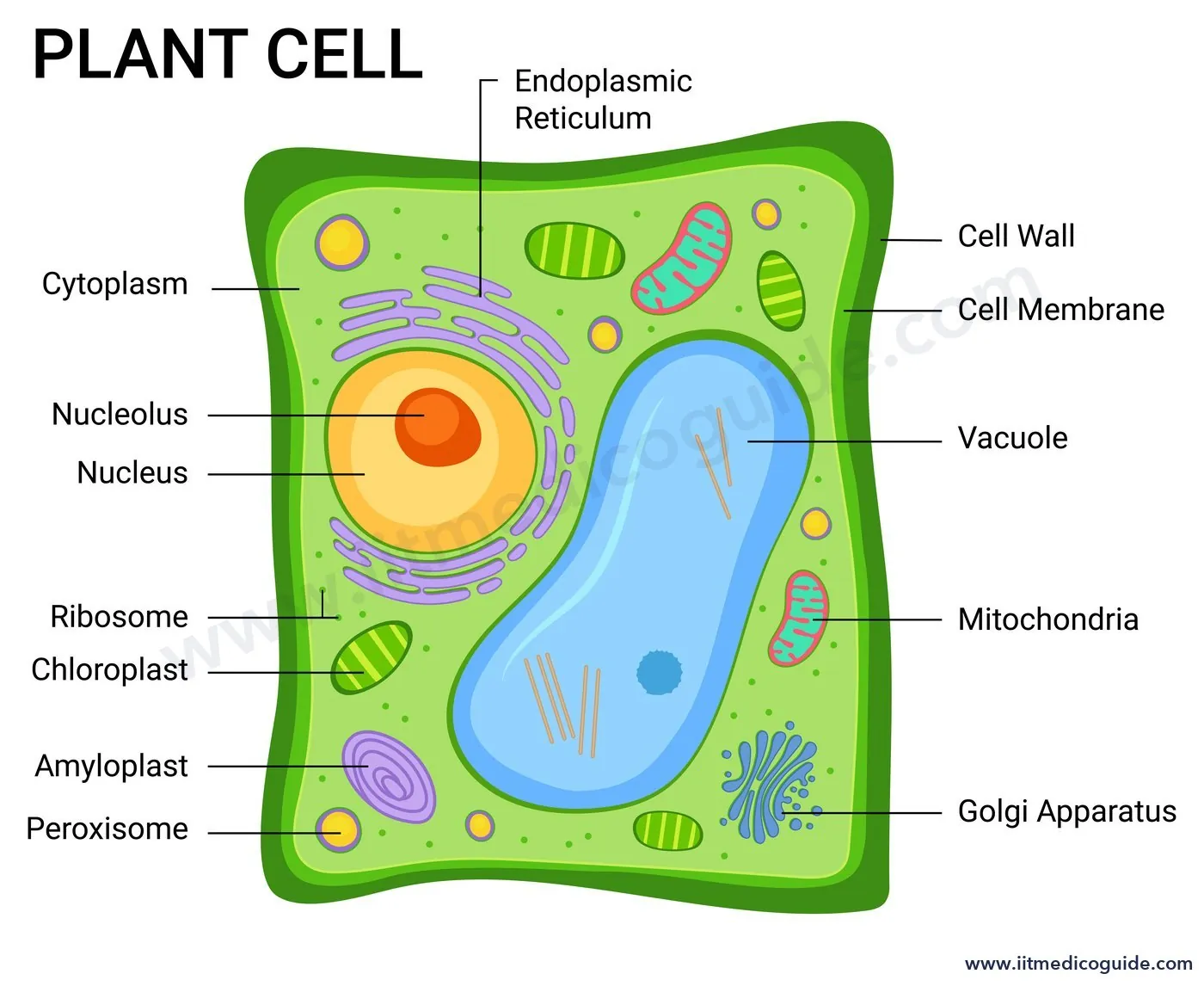
Plasma membrane
The accepted model is the fluid mosaic model of Singer and Nicolson (1972). Lipids form a bilayer with polar heads facing outwards and hydrophobic tails inwards; the membrane also contains cholesterol. Proteins are peripheral (on the surface) or integral (buried partly or wholly). In human RBC membranes, protein is about 52% and lipid about 40%. The quasi-fluid nature allows lateral movement of proteins, important for cell growth, intercellular junctions, secretion, endocytosis and cell division.
Transport: passive (along a gradient, by diffusion; water by osmosis) and active (against a gradient, using ATP, as in the Na+/K+ pump).
Cell wall
In algae the wall is made of cellulose, galactans, mannans and minerals like calcium carbonate; in other plants it has cellulose, hemicellulose, pectins and proteins. The primary wall of young cells can grow; the secondary wall forms on its inner side. The middle lamella, mainly calcium pectate, glues neighbouring cells. Plasmodesmata connect the cytoplasm of neighbouring cells through the wall.
Endomembrane system
The ER, Golgi complex, lysosomes and vacuoles have coordinated functions and together form this system. Mitochondria, chloroplasts and peroxisomes are not part of it, because their functions are not coordinated with these.
| Organelle | Structure | Function |
|---|---|---|
| Rough ER | Ribosomes on the outer surface; continuous with the outer nuclear membrane | Protein synthesis and secretion |
| Smooth ER | No ribosomes | Lipid synthesis; in animal cells, lipid-like steroidal hormones |
| Golgi apparatus | Described by Camillo Golgi (1898). Flat, disc-shaped cisternae (0.5 to 1.0 µm) stacked in parallel. Convex cis (forming) face and concave trans (maturing) face | Packaging and dispatch of materials; site of formation of glycoproteins and glycolipids |
| Lysosome | Membrane-bound vesicles formed by packaging in the Golgi | Hydrolytic enzymes (lipases, proteases, carbohydrases) active at acidic pH; digest carbohydrates, proteins, lipids, nucleic acids |
| Vacuole | Membrane-bound space (membrane = tonoplast); up to 90% of a plant cell's volume | Contains water, sap, excretory products; tonoplast moves ions into the vacuole against concentration gradients. Contractile vacuole in Amoeba for osmoregulation and excretion; food vacuoles in protists |
Mitochondria
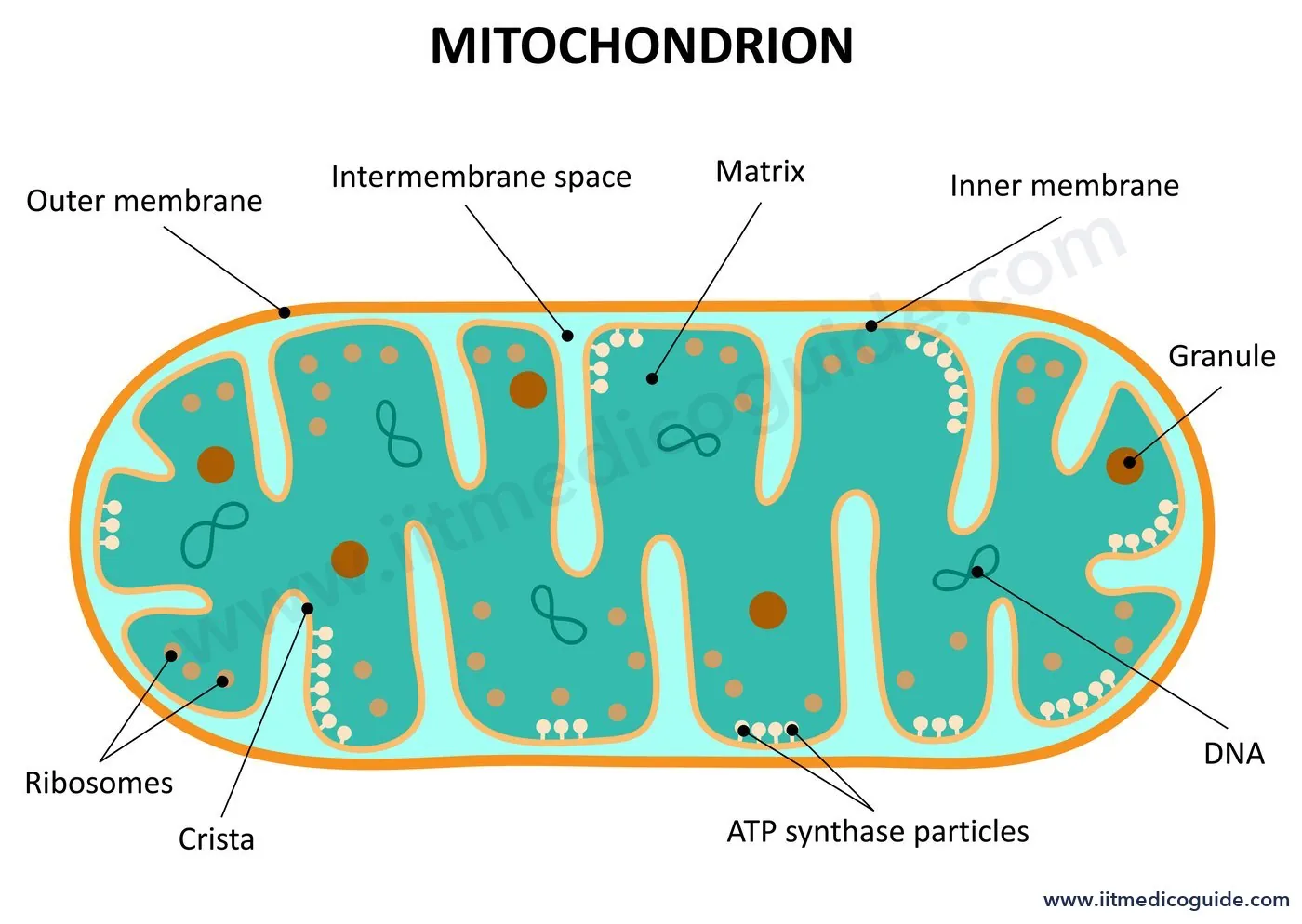
Mitochondria are sausage-shaped or cylindrical, about 0.2 to 1.0 µm in diameter (average 0.5 µm) and 1.0 to 4.1 µm long. Double membrane: the inner membrane forms infoldings called cristae, which increase the surface area. The matrix has a single circular DNA molecule, a few RNA molecules, 70S ribosomes and components for protein synthesis. Mitochondria divide by fission. They are the sites of aerobic respiration and produce ATP, hence "powerhouses of the cell".
Plastids
| Type | Contains | Notes |
|---|---|---|
| Chloroplasts | Chlorophyll and carotenoids | Trap light for photosynthesis |
| Chromoplasts | Fat-soluble carotenoids: carotene, xanthophylls | Yellow, orange or red colour |
| Leucoplasts | Colourless; store nutrients | Amyloplasts (starch, e.g. potato), elaioplasts (oils and fats), aleuroplasts (proteins) |
Chloroplast: lens-shaped, 5 to 10 µm long and 2 to 4 µm wide; from one per cell (Chlamydomonas) to 20 to 40 per cell in mesophyll. Double membrane; the inner membrane is relatively less permeable. Inside, the stroma contains flattened sacs called thylakoids, stacked like coins into grana, connected by flat stroma lamellae. Chlorophyll is in the thylakoids. The stroma has enzymes for carbohydrate and protein synthesis, small double-stranded circular DNA and 70S ribosomes.
Ribosomes
Ribosomes were first observed as dense particles by George Palade (1953) under the electron microscope. They are made of RNA and proteins and are not bound by any membrane. Eukaryotic ribosomes are 80S (60S + 40S); prokaryotic ribosomes are 70S (50S + 30S). "S" (Svedberg unit) is the sedimentation coefficient, an indirect measure of density and size, so the numbers do not add up.
Cytoskeleton, cilia, flagella and centrosome
- Cytoskeleton: microtubules, microfilaments and intermediate filaments; for mechanical support, motility and maintenance of cell shape.
- Cilia and flagella: covered by the plasma membrane; the core (axoneme) has nine pairs of peripheral doublet microtubules and a central pair: the 9 + 2 array. The central tubules are connected by bridges and enclosed by a central sheath, which connects to each peripheral doublet by a radial spoke. Peripheral doublets are interconnected by linkers. Both emerge from centriole-like basal bodies. Cilia are small and work like oars; flagella are longer and wave-like. Prokaryotic flagella are structurally different.
- Centrosome: two cylindrical centrioles lying perpendicular to each other, surrounded by amorphous pericentriolar material. Each centriole has a cartwheel organisation: nine evenly spaced peripheral fibrils of tubulin, each a triplet, with adjacent triplets linked. A central proteinaceous hub connects to the triplets by radial spokes. Centrioles form the basal bodies of cilia and flagella and the spindle fibres during animal cell division.
 Common trap: cilia and flagella have doublets in a 9 + 2 pattern; centrioles have triplets in a 9 + 0 cartwheel pattern.
Nucleus
- First described by Robert Brown (1831); its material was later named chromatin by Flemming because it stains with basic dyes.
- The nuclear envelope has two parallel membranes with a perinuclear space of 10 to 50 nm between them. The outer membrane is usually continuous with the ER and bears ribosomes. Nuclear pores allow movement of RNA and proteins in both directions.
- The nucleoplasm contains the nucleolus (not membrane-bound), the site of active rRNA synthesis. Nucleoli are larger and more numerous in cells actively making proteins.
- Chromatin is a network of nucleoprotein fibres: DNA with basic proteins called histones, some non-histone proteins and RNA. A single human cell has about two metres of DNA distributed among its 46 chromosomes (23 pairs).
- Mature mammalian erythrocytes and plant sieve tube cells lack a nucleus.
Chromosomes by centromere position
Every chromosome has a primary constriction, the centromere, with disc-shaped kinetochores on its sides.
| Type | Centromere position | Arms |
|---|---|---|
| Metacentric | Middle | Two equal arms |
| Sub-metacentric | Slightly away from the middle | One shorter, one longer arm |
| Acrocentric | Close to one end | One extremely short, one very long arm |
| Telocentric | Terminal | – |
Some chromosomes have a non-staining secondary constriction at a constant location, giving the appearance of a small fragment called the satellite.
Microbodies
Microbodies are minute membrane-bound vesicles containing various enzymes, present in both plant and animal cells.
NEET focus
- Contributors to cell theory; fluid mosaic model (Singer and Nicolson).
- Mesosome functions; pili vs fimbriae; inclusion bodies.
- Endomembrane system membership; cis and trans faces of Golgi; glycoprotein formation.
- 70S vs 80S ribosomes and the Svedberg unit.
- 9 + 2 axoneme vs 9 + 0 centriole; chromosome types; nucleolus as the site of rRNA synthesis.
Practice questions
"Omnis cellula-e cellula" was stated by:
- Schleiden
- Schwann
- Virchow
- Robert Brown
Show answer
Which of these is NOT part of the endomembrane system?
- Golgi complex
- Lysosome
- Mitochondrion
- Endoplasmic reticulum
Show answer
Glycoproteins and glycolipids are formed in the:
- Smooth ER
- Golgi apparatus
- Lysosome
- Nucleolus
Show answer
A chromosome with the centromere close to one end, giving one extremely short arm, is:
- Metacentric
- Sub-metacentric
- Acrocentric
- Telocentric
Show answer
The axoneme of a cilium has:
- 9 triplets, no central tubules
- 9 doublets and 2 central singlets
- 9 triplets and 2 central singlets
- 9 doublets, no central tubules
Show answer
Mesosomes in bacteria help in all EXCEPT:
- Cell wall formation
- DNA replication
- Respiration
- Protein synthesis on 80S ribosomes
Show answer
Amyloplasts store:
- Oils
- Proteins
- Starch
- Pigments