


 In this chapter: structure of DNA and RNA; packaging; Griffith, Avery and Hershey-Chase experiments; RNA world; replication (Meselson and Stahl); transcription and processing; genetic code; tRNA; translation; lac operon; Human Genome Project; DNA fingerprinting.
Structure of DNA
Size of genomes
| Organism | DNA length |
|---|---|
| Bacteriophage φ×174 | 5386 nucleotides |
| Bacteriophage lambda | 48,502 bp |
| E. coli | 4.6 × 10⁶ bp |
| Human (haploid) | 3.3 × 10⁹ bp |
The polynucleotide chain
- A nucleotide has a nitrogenous base, a pentose sugar and a phosphate. Bases: purines (adenine, guanine) and pyrimidines (cytosine, uracil, thymine). Thymine is 5-methyl uracil.
- The base joins the 1′ carbon of the sugar by an N-glycosidic linkage (forming a nucleoside). Phosphate joins the 5′ OH by a phosphoester linkage (forming a nucleotide). Nucleotides join by 3′-5′ phosphodiester linkages.
- A chain has a free phosphate at the 5′ end and a free OH at the 3′ end. The backbone is sugar and phosphate; the bases project from it.
- In RNA, each sugar (ribose) has an extra 2′-OH, and uracil replaces thymine.
The double helix
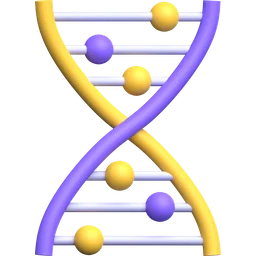
Friedrich Miescher (1869) first identified DNA as an acidic substance in the nucleus, which he called "nuclein". In 1953, James Watson and Francis Crick proposed the double helix, based on X-ray diffraction data from Maurice Wilkins and Rosalind Franklin. Erwin Chargaff had shown that in double-stranded DNA, A:T and G:C ratios are constant and equal to one.
- Two polynucleotide chains with anti-parallel polarity (one 5′→3′, the other 3′→5′).
- Bases pair by hydrogen bonds: A=T (two bonds), G≡C (three bonds). A purine always faces a pyrimidine, keeping the distance uniform.
- The chains coil in a right-handed fashion. Pitch = 3.4 nm, about 10 bp per turn, so about 0.34 nm between base pairs. Stacking of base pairs adds stability.
- Crick's central dogma: DNA → RNA → protein. In some viruses, information flows from RNA to DNA (reverse transcription).
Packaging of DNA
- Human DNA (6.6 × 10⁹ bp in a diploid cell) × 0.34 × 10⁻⁹ m ≈ 2.2 m long, packed into a nucleus of about 10−6 m. E. coli DNA is about 1.36 mm long (NCERT value).
- Prokaryotes: negatively charged DNA is held by some positively charged proteins in a region called the nucleoid, organised in large loops.
- Eukaryotes: positively charged basic proteins, histones, rich in lysine and arginine, form a unit of eight molecules, the histone octamer. DNA wraps around it to form a nucleosome, containing about 200 bp of DNA. Nucleosomes repeat along chromatin and look like "beads on a string" under the electron microscope.
- Chromatin fibres coil and condense further to form chromosomes at metaphase. Higher-level packaging needs non-histone chromosomal (NHC) proteins.
- Euchromatin: loosely packed, stains light, transcriptionally active. Heterochromatin: densely packed, stains dark, inactive.
The search for the genetic material
| Experiment | What was done | Conclusion |
|---|---|---|
| Griffith (1928) | Streptococcus pneumoniae: S strain (smooth, polysaccharide coat, virulent) and R strain (rough, no coat, non-virulent). Heat-killed S alone did not kill mice; heat-killed S + live R killed mice, and live S bacteria were recovered | R strain was transformed by a "transforming principle" from dead S cells |
| Avery, MacLeod and McCarty (1933 to 1944) | Purified biochemicals from heat-killed S. Proteases and RNases did not stop transformation; DNase did | DNA is the transforming substance (not all biologists were convinced) |
| Hershey and Chase (1952) | Bacteriophages grown with 32P (labels DNA) or 35S (labels protein), allowed to infect E. coli, then blended and centrifuged. Bacteria infected by 32P phages were radioactive; those infected by 35S phages were not | DNA, not protein, enters the bacterium: DNA is the genetic material |
DNA vs RNA as genetic material
A genetic material must replicate itself, be chemically and structurally stable, allow slow changes (mutations) for evolution, and express itself as Mendelian characters. RNA's 2′-OH makes it reactive and labile; it also acts as a catalyst. DNA is more stable (and thymine instead of uracil adds stability), so DNA is better for storing information, while RNA is better for transmitting it.
RNA world: RNA was probably the first genetic material. Essential processes (metabolism, translation, splicing) evolved around RNA, and some reactions are still catalysed by RNA. DNA evolved from RNA with modifications that make it more stable, and its double-stranded, complementary structure allows repair.
Replication
Semi-conservative replication
Watson and Crick proposed it, and Matthew Meselson and Franklin Stahl (1958) proved it:
- E. coli was grown for many generations in 15NH4Cl (heavy nitrogen), so its DNA became heavy.
- Cells were moved to normal 14NH4Cl and DNA was extracted at intervals and separated by caesium chloride (CsCl) density gradient centrifugation.
- After one generation (20 minutes; E. coli divides every 20 minutes), all DNA was of hybrid (intermediate) density.
- After two generations (40 minutes), DNA was equal amounts of hybrid and light.
Taylor and colleagues (1958) used radioactive thymidine on Vicia faba (faba bean) to show that chromosomal DNA also replicates semi-conservatively.
The machinery
- The main enzyme is DNA-dependent DNA polymerase. E. coli replicates its 4.6 × 10⁶ bp in about 18 minutes: roughly 2000 bp per second, with very high accuracy (errors cause mutations).
- Deoxyribonucleoside triphosphates act as both substrates and the energy source (their two terminal phosphates are high-energy, as in ATP).
- The strands cannot be separated along their whole length at once, so replication happens at a small opening, the replication fork.
- DNA polymerase works only in the 5′→3′ direction. On the template with 3′→5′ polarity, synthesis is continuous; on the template with 5′→3′ polarity, it is discontinuous, and the fragments are joined by DNA ligase.
- DNA polymerase cannot start replication on its own. Replication starts at a definite region, the origin of replication (ori). This is why a piece of DNA needs a vector (which provides an ori) to be propagated in recombinant DNA work.
- In eukaryotes, replication occurs in the S phase. If cell division fails after replication, polyploidy results.
Transcription
Transcription is the copying of information from one strand of DNA into RNA (with uracil pairing with adenine). Only one strand of a segment is copied. If both strands were copied, the two RNAs would be complementary, form double-stranded RNA and block translation, and the cell's machinery would become complicated.
The transcription unit
- Three regions: promoter, structural gene, terminator.
- The strand with 3′→5′ polarity is the template strand. The other (5′→3′), whose sequence matches the RNA (T instead of U), is the coding strand. All references are made with respect to the coding strand.
- The promoter is towards the 5′ end (upstream) of the structural gene and provides the binding site for RNA polymerase; it decides which strand is the template. The terminator is towards the 3′ end (downstream) and marks the end of transcription.
Gene, cistron, exons and introns
- A cistron is a segment of DNA coding for a polypeptide. Structural genes are monocistronic (mostly eukaryotes) or polycistronic (mostly prokaryotes).
- Eukaryotic genes are split genes: coding exons (which appear in mature RNA) are interrupted by introns (which do not).
Transcription in bacteria
- Three main RNAs: mRNA (template), tRNA (brings amino acids and reads the code), rRNA (structural and catalytic roles in translation).
- A single RNA polymerase makes all of them. It binds the promoter (initiation), polymerises using nucleoside triphosphates (elongation) and releases the RNA at the terminator (termination).
- RNA polymerase itself catalyses only elongation; it associates transiently with the sigma (σ) factor for initiation and the rho (ρ) factor for termination.
- No processing is needed, and since there is no nucleus, transcription and translation are coupled: translation can begin before the mRNA is complete.
Transcription in eukaryotes
| Enzyme | Transcribes |
|---|---|
| RNA polymerase I | rRNAs: 28S, 18S, 5.8S |
| RNA polymerase II | Precursor of mRNA: hnRNA (heterogeneous nuclear RNA) |
| RNA polymerase III | tRNA, 5S rRNA, snRNAs (small nuclear RNAs) |
The primary transcript (hnRNA) is processed:
- Splicing: introns removed, exons joined in order.
- Capping: an unusual nucleotide, methyl guanosine triphosphate, is added to the 5′ end.
- Tailing: 200 to 300 adenylate residues are added to the 3′ end, without a template.
The processed RNA (mRNA) leaves the nucleus for translation. Split genes and splicing are probably ancient features, reminders of the RNA world.
The genetic code
- Physicist George Gamow argued the code must be a triplet (43 = 64 combinations for 20 amino acids).
- Har Gobind Khorana developed chemical methods to synthesise RNA of defined base combinations; Marshall Nirenberg's cell-free protein-synthesis system and Severo Ochoa's enzyme (polynucleotide phosphorylase) also helped decipher the code.
Features of the code
- The codon is a triplet. 61 codons code for amino acids; 3 are stop codons (UAA, UAG, UGA).
- Unambiguous and specific: one codon codes for only one amino acid.
- Degenerate: some amino acids have more than one codon.
- Read in a contiguous fashion, with no punctuation.
- Nearly universal (UUU codes for phenylalanine from bacteria to humans), with some exceptions in mitochondria and some protozoans.
- AUG has two functions: it codes for methionine and is the initiator codon.
Frame-shift mutations (insertion or deletion of one or two bases) change the reading frame from that point. Inserting or deleting three bases (or multiples) adds or removes whole codons, keeping the frame. This proved that the code is a triplet read contiguously.
tRNA, the adapter
Crick postulated this adapter molecule. It has an anticodon loop complementary to the codon and an amino acid acceptor end. tRNAs are specific for each amino acid; a special initiator tRNA starts translation. There are no tRNAs for stop codons. Its secondary structure looks like a clover leaf; in reality it is a compact inverted L.
Translation
- First, amino acids are activated with ATP and attached to their tRNA: charging (aminoacylation) of tRNA.
- The ribosome has structural RNAs and about 80 proteins, in a large and a small subunit. Translation begins when the small subunit meets the mRNA. The large subunit has two sites where amino acids come close enough to form a peptide bond. In bacteria, the 23S rRNA catalyses peptide bond formation: it is a ribozyme.
- The translational unit runs from the start codon (AUG) to a stop codon. Untranslated regions (UTRs) at the 5′ end (before AUG) and 3′ end (after the stop codon) are needed for efficient translation.
- Initiation: the ribosome binds at AUG, recognised only by the initiator tRNA. Elongation: charged tRNAs pair with codons; the ribosome moves codon by codon, adding amino acids. Termination: a release factor binds the stop codon and releases the polypeptide.
Regulation of gene expression: the lac operon
In eukaryotes, regulation can occur at transcription, RNA processing (splicing), mRNA transport and translation. In prokaryotes, control of transcription initiation is predominant, through proteins binding operator sequences next to promoters.
The lac operon was described by François Jacob and Jacques Monod:
| Gene | Product | Role |
|---|---|---|
| i (regulatory; from "inhibitor") | Repressor | Made constitutively; binds the operator and blocks RNA polymerase |
| z | β-galactosidase | Hydrolyses lactose into galactose and glucose |
| y | Permease | Increases the cell's permeability to β-galactosides |
| a | Transacetylase | – |
- Lactose (or allolactose) is the inducer. In the absence of glucose, lactose enters the cell through permease (a very low level of expression is always present, otherwise lactose could not enter).
- No lactose: the repressor binds the operator; the operon is off.
- Lactose present: the inducer binds and inactivates the repressor; RNA polymerase reaches the promoter; the operon is transcribed.
- Control by a repressor is negative regulation. (The lac operon is also under positive regulation, not covered in NCERT.)
Human Genome Project (HGP)
- Launched in 1990, completed in 2003 (a 13-year project), coordinated by the US Department of Energy and the National Institutes of Health, with the Wellcome Trust (UK) as a major partner and contributions from Japan, France, Germany, China and others.
- Estimated cost about US$3 per bp, about US$9 billion. Printed at 1000 letters a page and 1000 pages a book, the sequence would fill 3300 books.
- Goals: identify all the approximately 20,000 to 25,000 human genes; sequence the 3 billion bp; store the data; improve analysis tools; transfer technologies; address ELSI (ethical, legal and social issues).
- Methods: Expressed Sequence Tags (ESTs), identifying genes expressed as RNA; and sequence annotation, sequencing the whole genome and assigning functions later. DNA was broken into fragments, cloned in hosts (bacteria, yeast) using BAC and YAC vectors, and sequenced by automated sequencers based on Frederick Sanger's method. Overlapping sequences were aligned by computer. Chromosome 1 was the last to be completed, in May 2006.
Salient features of the human genome
- About 3164.7 million bp.
- The average gene has 3000 bases; the largest known gene, dystrophin, has 2.4 million bases.
- About 30,000 genes, far fewer than the earlier estimates of 80,000 to 1,40,000. (NCERT quotes both 20,000-25,000 and about 30,000; learn the 30,000 figure for salient features.)
- 99.9% of bases are the same in all people.
- Functions are unknown for over 50% of discovered genes; less than 2% of the genome codes for proteins.
- Repeated sequences make up a very large portion.
- Chromosome 1 has the most genes (2968); Y the fewest (231).
- About 1.4 million SNPs (single nucleotide polymorphisms, "snips") were identified.
DNA fingerprinting
- Compares the 0.1% of DNA that differs between people, in regions of repetitive DNA.
- In density gradient centrifugation, bulk DNA forms a major peak and repetitive DNA forms small peaks: satellite DNA, classified as micro-satellites, mini-satellites etc. They usually do not code for proteins but show high polymorphism.
- Polymorphism arises by mutation; mutations in non-coding DNA accumulate over generations because they do not affect reproduction.
- Developed by Alec Jeffreys, using VNTRs (Variable Number of Tandem Repeats, a type of mini-satellite) as probes. The copy number varies greatly, so VNTR size ranges from 0.1 to 20 kb.
- Isolation of DNA
- Digestion with restriction endonucleases
- Separation of fragments by electrophoresis
- Blotting onto nitrocellulose or nylon membranes (Southern blotting)
- Hybridisation with a labelled VNTR probe
- Detection by autoradiography
The band pattern is unique to each person, except identical (monozygotic) twins. The same pattern is found in every tissue (blood, hair follicle, skin, bone, saliva, sperm), making it useful in forensics; since patterns are inherited, it is also used in paternity testing. With PCR, DNA from a single cell is enough.
 Common traps: (1) The coding strand has the same sequence as mRNA (except T for U); the template strand is 3′→5′. (2) Capping at 5′, tailing at 3′. (3) RNA polymerase II makes hnRNA; III makes tRNA, 5S rRNA and snRNA. (4) 23S rRNA is the ribozyme in bacteria. (5) Lactose is the inducer; the i gene makes the repressor. (6) Chromosome 1 has the most genes, Y the fewest.
NEET focus
- Numbers: 0.34 nm, 3.4 nm, 10 bp per turn, 2.2 m, 200 bp per nucleosome, 2000 bp/s, 18 minutes.
- Griffith, Avery-MacLeod-McCarty, Hershey-Chase, Meselson-Stahl: set-up and conclusion.
- Transcription unit and strands; three eukaryotic RNA polymerases; hnRNA processing.
- Features of the genetic code; stop codons; AUG; tRNA structure; UTRs; ribozyme.
- Lac operon genes and logic.
- HGP facts and figures; DNA fingerprinting steps and VNTRs.
Practice questions
In the Hershey-Chase experiment, radioactivity was found inside bacteria infected with phages grown in:
- 35S
- 32P
- 15N
- 14C
Show answer
After two generations in 14N medium, Meselson and Stahl found DNA to be:
- All hybrid
- All light
- Equal amounts of hybrid and light
- All heavy
Show answer
Which RNA polymerase transcribes hnRNA in eukaryotes?
- RNA polymerase I
- RNA polymerase II
- RNA polymerase III
- Primase
Show answer
The genetic code is called degenerate because:
- One codon codes for many amino acids
- Some amino acids are coded by more than one codon
- It has stop codons
- It is universal
Show answer
In the lac operon, the inducer is:
- Glucose
- Repressor
- Lactose (allolactose)
- β-galactosidase
Show answer
The distance between two consecutive base pairs in B-DNA is about:
- 3.4 nm
- 0.34 nm
- 34 nm
- 0.034 nm
Show answer
In the human genome, the chromosome with the fewest genes is:
- Chromosome 1
- Chromosome 21
- X
- Y
Show answer
DNA fingerprinting was developed by:
- Frederick Sanger
- Alec Jeffreys
- Kary Mullis
- Har Gobind Khorana