

 In this chapter: stamen and microsporogenesis; pollen grain; pistil, ovule and megasporogenesis; embryo sac; pollination types and agents; outbreeding devices; pollen-pistil interaction; artificial hybridisation; double fertilisation; endosperm, embryo, seed and fruit; apomixis and polyembryony.
The stamen and microsporogenesis
- A typical anther is bilobed, each lobe with two thecae (dithecous). It is tetragonal, with four microsporangia at the corners, two in each lobe. Microsporangia become pollen sacs.
- The microsporangium wall has four layers: epidermis, endothecium, middle layers and tapetum. The outer three protect and help dehiscence. The innermost tapetum nourishes the developing pollen; its cells have dense cytoplasm and generally more than one nucleus.
- The central sporogenous tissue forms pollen (microspore) mother cells, each of which undergoes meiosis to form a microspore tetrad. This is microsporogenesis. The microspores separate as the anther dries and become pollen grains.
The pollen grain (male gametophyte)
- Generally spherical, about 25 to 50 µm in diameter.
- Two-layered wall: the hard outer exine of sporopollenin, one of the most resistant organic materials known (it withstands high temperatures and strong acids and alkalis, and no enzyme degrades it); and the thin inner intine of cellulose and pectin. The exine has germ pores where sporopollenin is absent.
- A mature pollen grain has two cells: a large vegetative cell (abundant food reserve, large irregular nucleus) and a small, spindle-shaped generative cell floating in it.
- In over 60% of angiosperms, pollen is shed at this 2-celled stage. In the rest, the generative cell divides by mitosis to form two male gametes before shedding (3-celled stage).
- Pollen of some plants causes allergies; Parthenium (carrot grass), which came into India with imported wheat, is one. Pollen is also sold as a food supplement (pollen tablets).
- Viability: rice and wheat pollen lose viability within 30 minutes; some members of Rosaceae, Leguminosae and Solanaceae stay viable for months. Pollen can be stored for years in liquid nitrogen (−196 °C), in pollen banks, for crop breeding.
The pistil, ovule and megasporogenesis
A pistil has a stigma, style and ovary. Inside the ovary, ovules arise from the placenta.
The ovule (megasporangium)
- Attached to the placenta by a stalk, the funicle; the junction of ovule and funicle is the hilum.
- Covered by one or two protective integuments, except at a small opening, the micropyle. The opposite, basal end is the chalaza.
- Inside is the nucellus, a mass of cells with abundant reserve food, which contains the embryo sac (female gametophyte). An ovule generally has a single embryo sac.
Megasporogenesis and the embryo sac
- A single megaspore mother cell (MMC) differentiates in the micropylar region of the nucellus and undergoes meiosis, forming four megaspores.
- In most flowering plants, one megaspore is functional and the other three degenerate. Development of an embryo sac from a single megaspore is monosporic.
- The functional megaspore's nucleus divides by mitosis three times (2, 4 and then 8 nuclei). These are free-nuclear divisions: not immediately followed by wall formation.
- After the 8-nucleate stage, walls form. Six nuclei become cells; the remaining two, the polar nuclei, lie in a large central cell.
| Position | Cells | Notes |
|---|---|---|
| Micropylar end | Egg apparatus: 2 synergids + 1 egg cell | Synergids have special thickenings at the micropylar tip, the filiform apparatus, which guides the pollen tube into the synergid |
| Centre | Central cell with 2 polar nuclei | Forms the endosperm after triple fusion |
| Chalazal end | 3 antipodals | – |
 A typical angiosperm embryo sac at maturity is 8-nucleate and 7-celled.
Pollination
| Type | Transfer of pollen | Notes |
|---|---|---|
| Autogamy | Anther to stigma of the same flower | In chasmogamous (open) flowers it needs synchrony of pollen release and stigma receptivity. Cleistogamous flowers never open and are invariably autogamous, assuring seed set even without pollinators. Viola (pansy), Oxalis and Commelina produce both types |
| Geitonogamy | To a different flower of the same plant | Functionally cross-pollination (an agent is involved) but genetically similar to autogamy |
| Xenogamy | To a flower on a different plant | Brings genetically different pollen |
Agents of pollination
- Wind: pollen light and non-sticky; well-exposed stamens; large, often feathery stigmas; often a single ovule per ovary and many flowers packed in an inflorescence. Common in grasses. The tassels of a corn cob are its stigmas and styles.
- Water: quite rare, in about 30 genera, mostly monocots: Vallisneria and Hydrilla (fresh water), Zostera (marine sea-grass). In Vallisneria, the female flower reaches the surface on a long stalk and male flowers or pollen float to it. In sea-grasses, female flowers stay submerged and long, ribbon-like pollen grains are carried inside the water. Pollen is protected from wetting by a mucilaginous covering. Not all aquatic plants use water: water hyacinth and water lily are pollinated by insects or wind.
- Animals: bees (the dominant biotic agents), butterflies, flies, beetles, wasps, ants, moths, birds (sunbirds, hummingbirds), bats, some primates (lemurs), arboreal rodents and reptiles (gecko and garden lizard). Such flowers are large, colourful, fragrant and rich in nectar. Fly- and beetle-pollinated flowers often smell foul. Rewards are nectar and pollen; some flowers provide safe places to lay eggs. Amorphophallus has the tallest flower (about 6 feet). The moth and Yucca depend on each other: the moth lays eggs in the ovary locule and pollinates the flower; the larvae feed on developing seeds.
Outbreeding devices (discouraging self-pollination)
- Pollen release and stigma receptivity not synchronised.
- Anther and stigma placed at different positions.
- Self-incompatibility: a genetic mechanism that stops self-pollen from fertilising ovules by inhibiting pollen germination or tube growth in the pistil.
- Unisexual flowers: monoecious plants (castor, maize) prevent autogamy but not geitonogamy; dioecious plants (papaya) prevent both.
Pollen-pistil interaction and artificial hybridisation
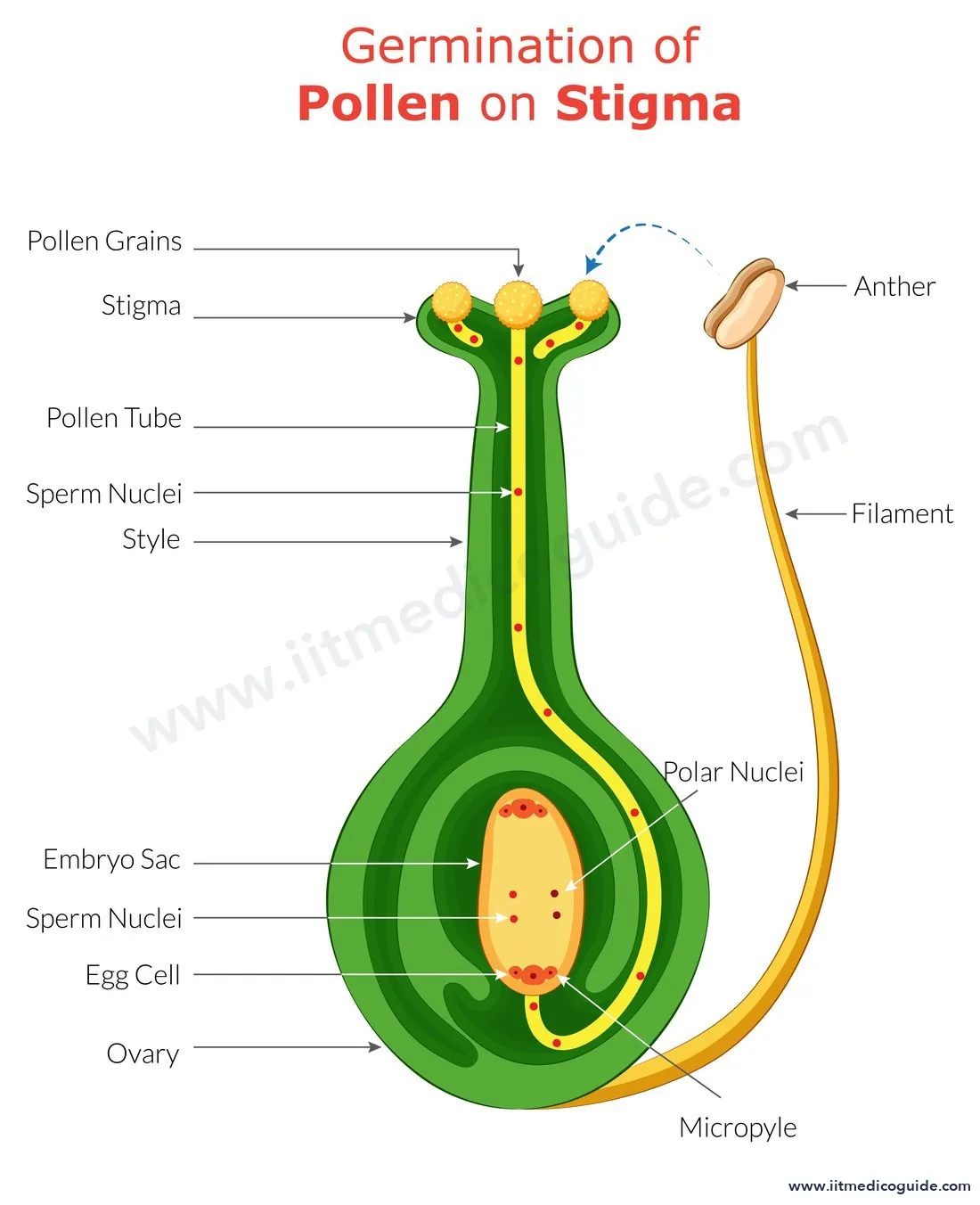
The pistil recognises whether pollen is compatible. Compatible pollen germinates, sending a pollen tube out through a germ pore. The tube grows through the stigma and style to the ovary. In plants shed at the 2-celled stage, the generative cell divides into two male gametes inside the growing tube. The tube enters the ovule through the micropyle and then enters one of the synergids through the filiform apparatus.
Artificial hybridisation uses only the desired pollen:
- Emasculation: removing the anthers from a bisexual flower bud with forceps before they dehisce.
- Bagging: covering the emasculated flower with a bag (generally butter paper) to prevent contamination. When the stigma becomes receptive, pollen from the male parent is dusted on it and the flower is rebagged.
- If the female parent has unisexual flowers, emasculation is not needed; the flower buds are bagged before they open.
Double fertilisation
The pollen tube releases two male gametes into the synergid.
- Syngamy: one male gamete fuses with the egg, forming a diploid zygote.
- Triple fusion: the other fuses with the two polar nuclei, forming the triploid primary endosperm nucleus (PEN). The central cell becomes the primary endosperm cell.
Because two fusions take place in one embryo sac, the event is called double fertilisation. It is unique to flowering plants.
Post-fertilisation events
Endosperm
Endosperm develops before the embryo. The primary endosperm cell divides to form triploid endosperm tissue, filled with reserve food that nourishes the embryo. Most commonly, the PEN undergoes many nuclear divisions to form free-nuclear endosperm, followed later by wall formation (cellular endosperm). In a tender coconut, the coconut water is free-nuclear endosperm (thousands of nuclei) and the surrounding white kernel is cellular endosperm. The endosperm may be completely used up before the seed matures (pea, groundnut, beans) or persist in the mature seed (castor, coconut).
Embryo
The embryo develops at the micropylar end. Most zygotes divide only after some endosperm has formed. Stages: proembryo, globular, heart-shaped, mature embryo.
| Dicot embryo | Monocot (grass) embryo |
|---|---|
| Embryonal axis with two cotyledons | One cotyledon, the scutellum, on one side of the axis |
| Epicotyl (above cotyledons) ends in the plumule | Epicotyl with shoot apex and a few leaf primordia, enclosed in the coleoptile |
| Hypocotyl (below cotyledons) ends in the radicle, covered by a root cap | Radicle and root cap enclosed in the coleorhiza |
Seed
- The seed is the fertilised ovule. It has seed coat(s), cotyledon(s) and an embryo axis. Cotyledons are often thick with stored food, as in legumes.
- Non-albuminous seeds have no residual endosperm (pea, groundnut). Albuminous seeds retain part of it (wheat, maize, barley, castor).
- Sometimes remnants of the nucellus persist as perisperm (black pepper, beet).
- Integuments harden into seed coats; the micropyle remains as a small pore for entry of oxygen and water during germination.
- Mature seeds are relatively dry, with 10 to 15% moisture; the embryo may enter dormancy.
- Record viability: a seed of Lupinus arcticus from the Arctic tundra germinated after an estimated 10,000 years; a 2000-year-old viable seed of the date palm Phoenix dactylifera was found at King Herod's palace near the Dead Sea.
Fruit
The ovary becomes the fruit and the ovary wall becomes the pericarp. In false fruits, the thalamus also contributes (apple, strawberry, cashew). True fruits develop only from the ovary. Parthenocarpic fruits develop without fertilisation and are seedless (banana); they can be induced with growth hormones.
Apomixis and polyembryony
- Apomixis: seeds produced without fertilisation, a form of asexual reproduction that mimics sexual reproduction. Seen in some species of Asteraceae and grasses. In some, a diploid egg forms without reduction division and develops into an embryo without fertilisation.
- More often, as in many Citrus and mango varieties, some nucellar cells around the embryo sac divide, protrude into it and form embryos, so one seed has many embryos: polyembryony.
- Importance: hybrid seeds must be produced every year because the characters segregate in the next generation. If hybrids could be made apomictic, there would be no segregation, and farmers could keep using the same hybrid seed year after year.
 Common traps: (1) The embryo sac is 8-nucleate and 7-celled (the central cell has two nuclei). (2) The filiform apparatus is on the synergids, not the egg. (3) Geitonogamy is genetically like autogamy. (4) Monoecious plants prevent autogamy only; dioecious plants prevent both. (5) Coconut water = free-nuclear endosperm. (6) Perisperm is nucellus, not endosperm.
NEET focus
- Wall layers of microsporangium; sporopollenin; 2-celled vs 3-celled pollen; viability numbers.
- Ovule parts; monosporic development; 8-nucleate 7-celled embryo sac.
- Pollination types, agents and examples (Vallisneria, Zostera, Yucca); outbreeding devices.
- Emasculation and bagging; syngamy vs triple fusion.
- Endosperm types; albuminous vs non-albuminous; perisperm; false and parthenocarpic fruits; apomixis.
Practice questions
The innermost wall layer of the microsporangium that nourishes developing pollen is the:
- Endothecium
- Middle layer
- Tapetum
- Epidermis
Show answer
A typical angiosperm embryo sac at maturity is:
- 7-nucleate, 8-celled
- 8-nucleate, 7-celled
- 8-nucleate, 8-celled
- 4-nucleate, 4-celled
Show answer
Which flowers are invariably autogamous?
- Chasmogamous
- Cleistogamous
- Dioecious
- Wind-pollinated
Show answer
Triple fusion produces:
- The zygote
- The primary endosperm nucleus
- The synergid
- The pollen tube
Show answer
Which plant prevents both autogamy and geitonogamy?
- Castor
- Maize
- Papaya
- Viola
Show answer
The persistent nucellus in a seed, as in black pepper, is called:
- Endosperm
- Perisperm
- Pericarp
- Scutellum
Show answer
Polyembryony in Citrus is commonly due to embryos arising from:
- Synergids
- Antipodals
- Nucellar cells
- Integuments